
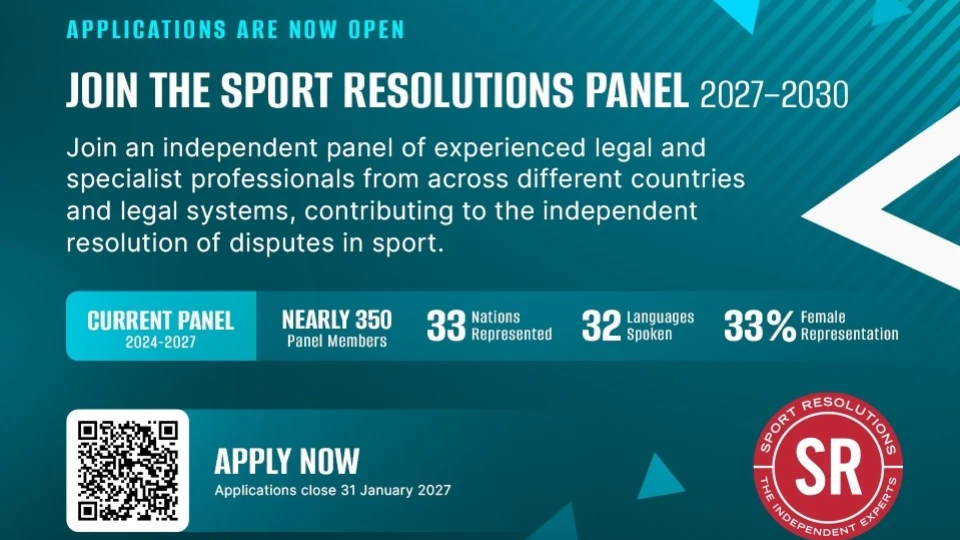
Sport Resolutions opens applications for its 2027–2030 Panel
Sport Resolutions is pleased to announce that applications are now open for its 2027–2030 Panel, with applications welcomed from suitably qualified professionals from around the world

Mon, August 16, 2021
To optimise for archiving, the original image and related documents associated with this article have been removed.
The International Skating Union (ISU) has released a transgender policy which details criteria for transgender athletes to be able to compete.
The ISU has stated that those transitioning from female to male are eligible to compete in the men’s category without restriction as long as they can provide a signed declaration confirming their gender identity.
Athletes transitioning from male to female have to also declare their gender identity as female and this cannot be changed for another four years. Further criteria that must be met are evidencing that their testosterone level has been below five nanomoles per litre continuously for at least 12 months prior to competition. Once this criteria is met they are eligible to compete in the women’s category. Should the criteria not be met skaters will be suspended for 12 months.
The ISU said “To avoid discrimination, if not eligible for women’s competition the skater should be eligible to compete in men’s competition” and that “all forms of abuse and/or harassment are prohibited.”
The ISU is the latest governing body to update its transgender policy after the IOC recently said its own policy was outdated. Last month weightlifter Laurel Hubbard became the first trans woman to compete at an Olympic Games but other governing bodies such as World Rugby has banned trans women from competing in the women's game as physiological advantages could lead to injuries. World Athletics introduced its own guidelines in 2019, which require transgender athletes to be less than five nmol/L to participate in events.
You can read the ISU statement here.
Sport Resolutions is pleased to announce that applications are now open for its 2027–2030 Panel, with applications welcomed from suitably qualified professionals from around the world

Women football players are most likely to consider retiring early due to financial and mental health issues, with employment standards failing to keep pace with a boom in certain areas, as reported by FIFPRO
The Women Super League, the highest level of women's football in England, is set to receive additional investment in match officiating, with full-time referees expected to be introduced in 2029