
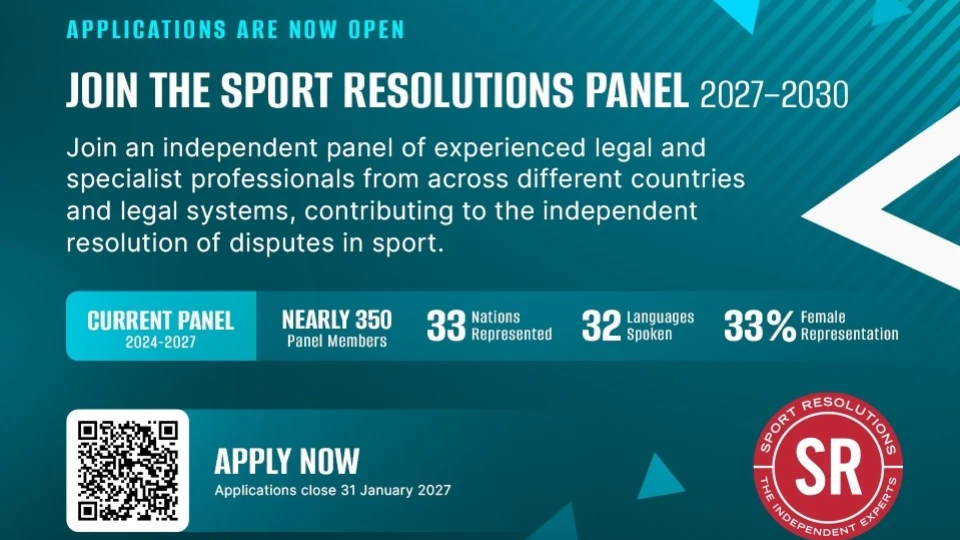
Sport Resolutions opens applications for its 2027–2030 Panel
Sport Resolutions is pleased to announce that applications are now open for its 2027–2030 Panel, with applications welcomed from suitably qualified professionals from around the world

Wed, May 24, 2023
To optimise for archiving, the original image and related documents associated with this article have been removed.
The World Anti-Doping Agency (WADA) and the Global Esport Federation (GEF) have said they will work on a doping education programme that could lead to signing onto the WADA Code and open the door to the Olympics.
WADA has told Reuters that it has been approached by GEF in relation to delivering an education programme to gamers that would detail the dangers of performance enhancing drugs. WADA director general Olivier Niggli said “Esport Federation realises that they have now a real need to start educating their players because they see there are challenges in the abuse of substances. They play for 16-18 hours a day, they have a bad lifestyle that is not very healthy. They have a health concern first. Doping is one of them. Clearly the way they are playing requires some support if you are playing a game 18 hours in a row behind a screen.”
Esports currently has no regulatory body with GEF board member Melita Moore saying “There is not a regulatory body in esports. Therefore, the word doping does not exist in the same context as it does in traditional sport. Which means there isn't anti-doping measures that are or can be put in place. I do believe that in the future, there will be a regulatory body and doping will become part of the nomenclature used in esports.”
IOC President Thomas Bach previously stated that Esports could be a part of the Olympics in the future but that will not be possible until a regulatory body is created and is a signatory to the WADA Code.
Sport Resolutions is pleased to announce that applications are now open for its 2027–2030 Panel, with applications welcomed from suitably qualified professionals from around the world

Women football players are most likely to consider retiring early due to financial and mental health issues, with employment standards failing to keep pace with a boom in certain areas, as reported by FIFPRO
The Women Super League, the highest level of women's football in England, is set to receive additional investment in match officiating, with full-time referees expected to be introduced in 2029