
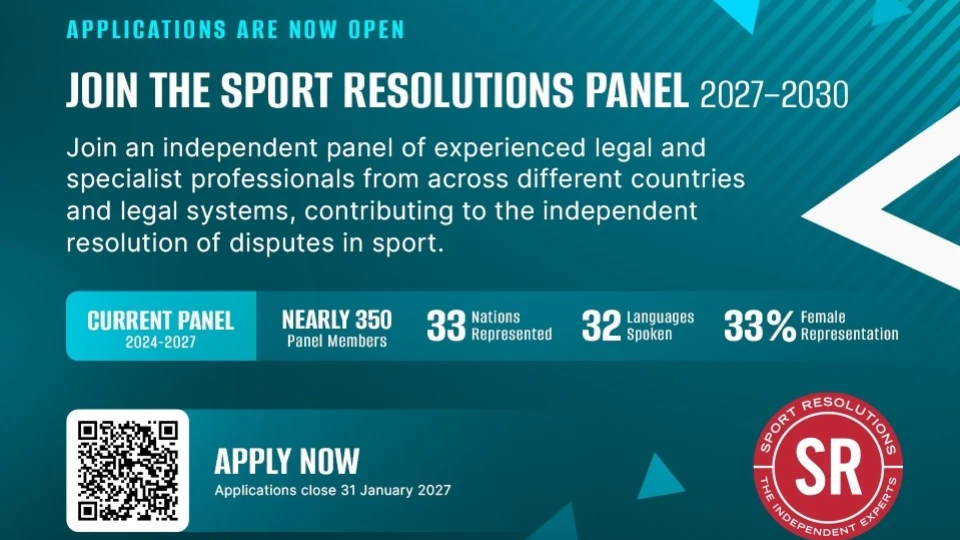
Sport Resolutions opens applications for its 2027–2030 Panel
Sport Resolutions is pleased to announce that applications are now open for its 2027–2030 Panel, with applications welcomed from suitably qualified professionals from around the world

Tue, June 14, 2022
To optimise for archiving, the original image and related documents associated with this article have been removed.
A decision in the mater of UK Anti-Doping (UKAD) v Marc Shackley has been published by the National Anti-Doping Panel (NADP).
On 14 September 2021, Mr Marc Shackley, a Professional rugby football league player, provided a urine Sample Out-of-Competition. The Sample returned an Adverse Analytical Finding (AAF) for clenbuterol.
Mr Shackley was subsequently charged on 19 November 2021, with a breach of ADR Articles 2.1 and 2.2 for the Presence of a Prohibited Substance or its Metabolites or Markers in his Sample, and 2.2 for Use or Attempted Use by an Athlete of a Prohibited Substance or a Prohibited Method. Mr Shackley admitted the Anti-Doping Rule Violations (ADRVs) but contested UKAD’s jurisdiction due to retiring from the sport. The NADP Tribunal, consisting of Mark Hovell (Chair), Dr Neil Townshend and Professor Gordon McInnes found Mr Shackley had committed the ADRVs pursuant to ADR Articles 2.1 and 2.2, and that he had not discharged the burden on him under ADR Article 10.2.1(a) to establish the ADRVs were not intentional. A period of Ineligibility of four years was imposed which will commence from 08 October 2021 and ends 11:59 on 07 October 2025.
A copy of the full decision can be accessed in the Related Documents section.
The National Anti-Doping Panel (NADP) is the United Kingdom’s independent tribunal responsible for adjudicating anti-doping disputes in sport. It is operated by Sport Resolutions and is entirely independent of UK Anti-Doping who is responsible for investigating, charging and prosecuting cases before the NADP.
Sport Resolutions is pleased to announce that applications are now open for its 2027–2030 Panel, with applications welcomed from suitably qualified professionals from around the world

Women football players are most likely to consider retiring early due to financial and mental health issues, with employment standards failing to keep pace with a boom in certain areas, as reported by FIFPRO
The Women Super League, the highest level of women's football in England, is set to receive additional investment in match officiating, with full-time referees expected to be introduced in 2029