
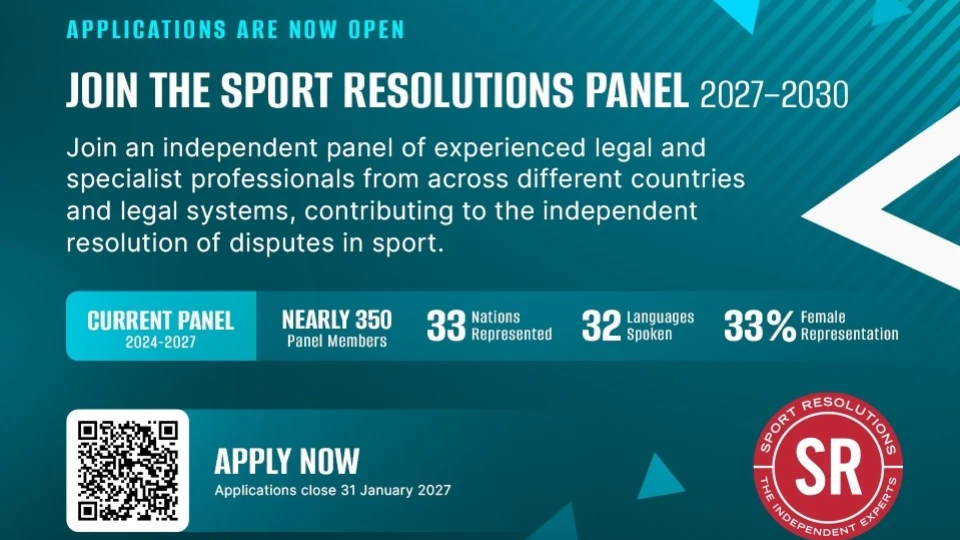
Sport Resolutions opens applications for its 2027–2030 Panel
Sport Resolutions is pleased to announce that applications are now open for its 2027–2030 Panel, with applications welcomed from suitably qualified professionals from around the world

Thu, November 19, 2026
A peer-reviewed study by the International Testing Agency (ITA) has confirmed that short-distance drone transport can preserve the integrity of anti-doping samples while significantly reducing transport times compared with road transport.
Test flights were undertaken in Doha as part of a study conducted in collaboration with the Anti-Doping Laboratory Qatar and Swiss company RigiTech.
Blood, urine and Dried Blood Spot (DBS) samples were transported by quadcopter drone and by car over distances of 5 km and 20 km, with a third set of samples remaining untransported as a control. Flights took place in temperatures of 29 to 32 degrees Celsius and winds of up to 20 kilometres per hour.
Researchers assessed a broad range of anti-doping relevant biomarkers, which are measurable biological indicators in blood or urine that can help detect the use of prohibited substances or methods. These included Athlete Biological Passport haematological parameters, the urinary steroid profile, routine clinical chemistry markers and the metabolomic profile of DBS samples.
The study found no significant differences between car and drone transport for the key haematological, steroidal and routine clinical chemistry biomarkers examined. Across the 664 metabolites detected in DBS samples, 92.3% were classified as equivalent between drone and car transport at 5 km and 88.0% at 20 km. No metabolite showed opposing directional changes between the two transport modes.
ITA Director General, Benjamin Cohen, said: “This gives us a stronger scientific basis to continue exploring where drone technology could provide a practical additional solution for anti-doping, particularly when speed, distance or geography create transport challenges.”
This initial study forms part of the ITA's wider ‘Integrity in Flight’ project. However, as reported by Inside the Games, “the authors of the Qatar study also acknowledge limitations: the number of participants was small and predominantly male, the aircraft had a payload capacity of 2.5 kilograms, and flight permits restricted the distances tested. Any wider deployment would also have to ensure security, chain of custody and compliance with aviation regulations.”
Furthermore, further validation over longer distances and across a wider range of operational conditions is needed before broader implementation.
The ITA has since extended its research significantly, most recently through a 1,000 km ultra-long-distance test flight in Nenana, Alaska, in collaboration with the University of Alaska Fairbanks and Sysmex America. Scientific results from this phase have yet to be released.
Road transport will naturally continue to be used, but drones may provide an additional solution in specific situations, including major sporting events, congested urban environments, mountainous regions and remote locations.
The full study, titled: ‘Impact of Drone Versus Car Transport on Anti-Doping Sample Integrity Over Short Distances: A Proof-of-Concept Study,’ is available here.
The ITA's announcement can be found here.
Sport Resolutions is pleased to announce that applications are now open for its 2027–2030 Panel, with applications welcomed from suitably qualified professionals from around the world

A decision in the case of the International Tennis Integrity Agency against Ms Jessica Eudovic has been issued by the Independent Tribunal

Bill Fennelly, the women’s basketball coach for Iowa State University, has been handed a one-game ban for pushing a player’s forehead