
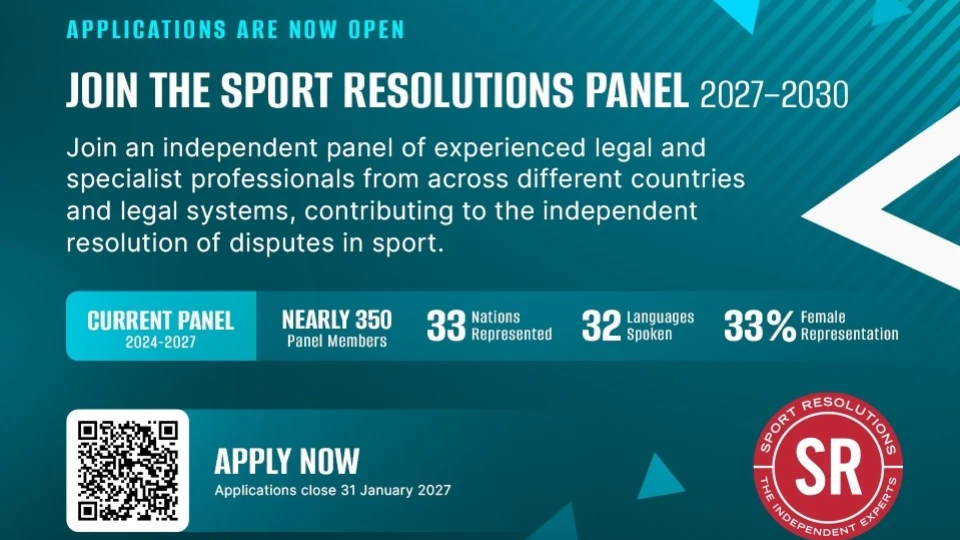
Sport Resolutions opens applications for its 2027–2030 Panel
Sport Resolutions is pleased to announce that applications are now open for its 2027–2030 Panel, with applications welcomed from suitably qualified professionals from around the world
Wed, February 12, 2025

World Athletics’ female eligibility guidelines are being updated to “reflect the latest developments in science, sport and law,” and widespread consultation will take place with key stakeholders.
On Monday, World Athletics launched a new consultation process on its updated eligibility conditions for the Female Category and the current Differences in sex development (DSD) Regulations and Transgender (TG) Regulations.
The consultation period, which lasts from 10 February - 5 March 2025, is a recommendation by its Working Group on Gender Diverse Athletes and has been approved by the World Athletics Council.
In 2023, World Athletics voted to ban transgender women who have undergone male puberty from competing in women's events and announced the establishment of its Working Group to further study the issue of transgender inclusion.
World Athletics stated: “New evidence makes it clear that there is a significant difference in athletic performance even before the onset of puberty. The performance difference in childhood or before puberty in athletics specifically is between three and five per cent in running events and even greater in throwing and jumping events…
Emerging evidence shows that the athletic disadvantages associated with female body structure and physiology contribute to this performance gap.”
Therefore, World Athletics decided that: “In the course of its work through 2024, the Working Group learned of key scientific developments that, in light of its core commitments, make it appropriate to amend the DSD and TG Regulations.”
The World Athletics Working Group submitted the following five recommendations to the Council in December 2024 which were approved and are now set for consultation:
Any standing DSD and Transgender Regulations will be implemented with the following standing commitments:
In regard to Merging the DSD and Transgender Regulations, it was also suggested that DSD athletes, such as double Olympic 800m champion Caster Semenya, should be subject to the same rules as transgender athletes. Under current World Athletics rules, DSD athletes must reduce their testosterone levels below 2.5 nmol/L for at least six months to be eligible to compete. This can be achieved by medical or surgical means.
The Working Group noted that the current TG regulations do not permit transgender women who have experienced male puberty, while the DSD regulations allow XY DSD athletes who have undergone the same experience to compete.
As a result, the Working Group recommended the use of a sex-screening method, such as a buccal swab test or dried blood spot analysis, for athletes wishing to compete in the female elite category. This would allow for the detection of the SRY gene, which determines male sex.
World Athletics President Sebastian Coe expressed: “World Athletics is a leader in preserving the female category in sport and one of the first international sports federations to establish clear policies on female eligibility in elite sport…
While our current Eligibility Regulations for DSD and Transgender athletes are robust and based on the science available at the time of our last consultation, several scientific developments in this field have emerged since then and it is our role, as the global governing body for athletics, to ensure that our guidelines keep up with the latest information available to maintain a fair and level-playing field in the Female Category…
Preserving the integrity of competition in the Female Category is a fundamental principle of the sport of Athletics and we look forward to this collaborative consultation process with our key stakeholders in this area.”
Coe’s stance is likely to be a point of debate in the International Olympic Committee (IOC) leadership race, where he is a contender, as policies on gender inclusion continue to be subject of debate in global sport.
For example, the International Boxing Association (IBA) announced it is to take legal action against the IOC over the inclusion of Algeria's Imane Khelif and Taiwan's Lin Yu-ting at last year's Olympic Games. The two female boxers had been excluded from the IBA's 2023 world championships after the fighters failed gender eligibility tests, but the IOC cleared them to fight, and both went on to win gold medals in Paris. However, the IOC stated that the IBA’s tests were biased, and that Khelif was “born a woman.”
In response to the IBA’s actions, Khelif expressed on Instagram: “For two years, I have taken the high road while my name and image have been used, unauthorised, to further personal and political agendas through the spreading and dissemination of baseless lies and misinformation..
I will continue to compete with honour and integrity. I am not going anywhere. I will fight in the ring, I will fight in the courts, and I will fight in the public eye until the truth is undeniable.”
Coe hit out at the IOC as he believes it does not have a policy to deal with the current controversy over gender eligibility in Olympic boxing. “It's simple: have a policy,” he voiced.
The full consultation document setting out the background, the key developments since March 2023 (when the current DSD Regulations and Transgender Regulations were last consulted on) and the recommendations to revise eligibility conditions to the Female Category can be found here.
Sport Resolutions is pleased to announce that applications are now open for its 2027–2030 Panel, with applications welcomed from suitably qualified professionals from around the world

Women football players are most likely to consider retiring early due to financial and mental health issues, with employment standards failing to keep pace with a boom in certain areas, as reported by FIFPRO
The Women Super League, the highest level of women's football in England, is set to receive additional investment in match officiating, with full-time referees expected to be introduced in 2029