
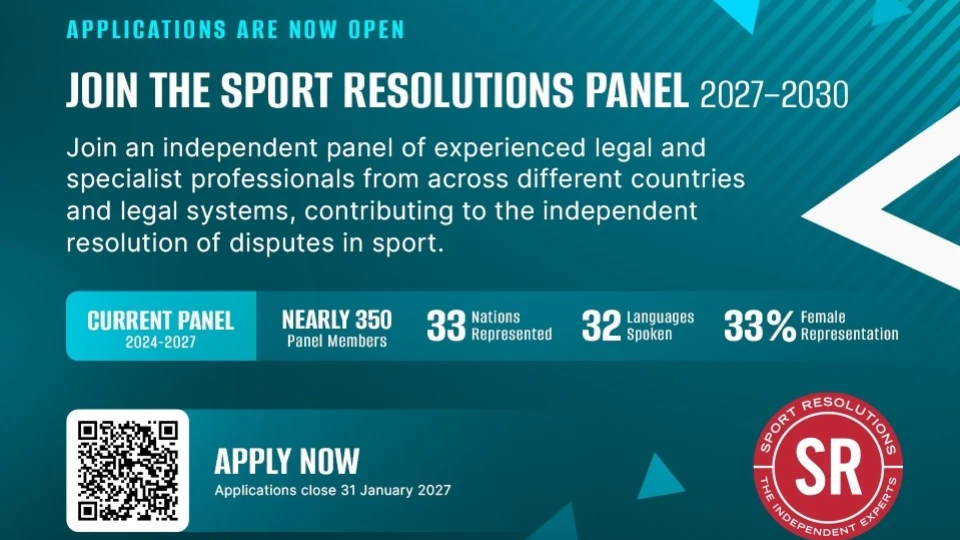
Sport Resolutions opens applications for its 2027–2030 Panel
Sport Resolutions is pleased to announce that applications are now open for its 2027–2030 Panel, with applications welcomed from suitably qualified professionals from around the world

Fri, November 13, 2026

A decision in the case of World Athletics (“WA”), represented by the Athletics Integrity Unit (“AIU”), against Mr Bo Li has been issued by the Disciplinary and Appeals Tribunal.
The decision concerns Mr Bo Li, a 32-year-old amateur road runner from China. As an International-Level Athlete, he is subject to and bound by the WA Anti-Doping Rules (“ADR”).
On 21 September 2025, an In-Competition urine Sample was collected from Mr Li at the 2025 Taiyuan Marathon in Taiyuan, China (the “Race”). The Sample was divided into an A Sample and a B Sample. Analysis of the A Sample by the WADA-accredited Laboratory in Beijing identified a Metabolite of Oxandrolone, resulting in an Adverse Analytical Finding (“AAF”). Oxandrolone is an Anabolic Androgenic Steroid listed under S1.1 of the WADA 2025 Prohibited List. It is a Non-Specified Substance and is prohibited at all times. The AIU determined that Mr Li held no Therapeutic Use Exemption and that there was no apparent departure from the relevant International Standards that could reasonably have caused the AAF.
On 20 October 2025, the AIU issued a Notice of Allegation and imposed a Provisional Suspension. Mr Li applied to lift the Provisional Suspension on 24 October 2025, suggesting that contaminated food at the Race hotel was the likely source of the Prohibited Substance. The AIU rejected the application on 17 November 2025, noting the absence of any supporting evidence. Analysis of the B Sample, conducted on 7 November 2025 in the presence of Mr Li and his representative, confirmed the result of the A Sample.
Mr Li subsequently arranged for a number of supplements to be tested. Two Chinese institutes produced contradictory results: the Beijing institute reported Oxandrolone in three products and in a sample of pigeon meat, while the Shenzhen institute detected none. The three products were then analysed by the WADA-accredited Laboratory in Seibersdorf, Austria, which found no Oxandrolone. In his written explanation of 3 April 2026, Mr Li maintained that he had no intention to dope and suggested that the AAF might have resulted from shared drinks, including a water bottle shared with a fellow runner, Mr Xue Jun, who later tested positive for Oxandrolone, from environmental contamination at his training base, or from contaminated meat. On 6 May 2026, the AIU charged Mr Li with anti-doping rule violations (“ADRVs”) under Rules 2.1 and 2.2 ADR (Presence and Use of a Prohibited Substance), and on 19 May 2026 he requested a hearing.
The matter was referred to the Disciplinary and Appeals Tribunal. On 1 June 2026, Mr Nick De Marco KC was appointed to chair the Panel, and the Parties subsequently agreed that he would sit as Sole Chair.
The AIU submitted that the ADRVs were established and that, under CAS jurisprudence, an Athlete may demonstrate an absence of intent without proving the source of a Prohibited Substance only in the rarest of cases, and then only with concrete and persuasive evidence. In its view, none of Mr Li’s explanations met that standard. Its expert, Professor Martial Saugy, considered each of them to be extremely unlikely. He observed that Oxandrolone is available only in tablet form and does not dissolve readily in water, that any quantity transferred through a shared bottle would be negligible, and that the substance has no transdermal properties. He further concluded that the Beijing institute’s own analytical data did not in fact show Oxandrolone in any of the products or in the pigeon meat.
Mr Li initially denied both ADRVs and argued that he bore No Fault or Negligence or, alternatively, No Significant Fault or Negligence, and in the further alternative that any ADRV was not intentional. He relied on the Beijing institute’s findings, on pigeon meat he had purchased and eaten at the training base, and on the positive test of Mr Jun for the same Prohibited Substance. He also pointed to the trace-level concentrations detected, the lack of any benefit that Oxandrolone could offer a marathon runner, his intention to retire after the 2025 National Games, his clean record, a voluntary polygraph examination, and statements as to his character from coaches and colleagues. He cited a number of CAS decisions, including Ademi, Villanueva and Lawson, in support of the proposition that the source of a Prohibited Substance need not be established in order to disprove intent.
A hearing took place by videoconference on 9 September 2026. By that stage the issues had narrowed considerably. Mr Li no longer seriously contested the ADRVs or pursued his arguments under No Fault or Negligence, and the sole remaining question was whether the ADRVs were intentional. The Sole Chair found Mr Li to be a truthful witness and accepted the evidence of Professor Saugy, noting that Mr Li had not called an expert of his own.
The Sole Chair found that Mr Li could not rely on No Fault or Negligence or No Significant Fault or Negligence, since he had been unable to establish how the Oxandrolone entered his system, and that the scientific evidence rendered each of his explanations very unlikely. He held, however, that establishing the source of the Prohibited Substance is not a prerequisite to showing that an ADRV was unintentional, and that the standard of proof borne by the Athlete is not heightened by his inability to do so. The Sole Chair gave weight to Mr Li’s credible and consistent denial, his status as an amateur Athlete of limited means with little to gain from doping, and his long and unblemished record. He also took into account a sponsorship agreement that depended on Mr Li not doping, the positive test of Mr Jun, with whom he had trained, eaten and drunk, and the fact that Oxandrolone is an unlikely choice for a long-distance runner, particularly at the trace concentrations found. He further accepted that Mr Li’s limited means bore on the weight to be given to his failure to test all of his supplements or to instruct an expert.
The Sole Chair observed that no single factor would have sufficed, but that together they formed a body of credible evidence in Mr Li’s favour. He concluded that Mr Li had met the burden of establishing, on the balance of probabilities, that the ADRVs were not intentional.
Mr Li was accordingly sanctioned with a period of Ineligibility of two (2) years, commencing on the date of the decision, with credit for the Provisional Suspension served since 20 October 2025. The period of Ineligibility will therefore expire on 19 October 2027. His individual results at the Race, together with all competitive results obtained between the date of Sample collection and the commencement of the Provisional Suspension were Disqualified, with forfeiture of any medals, titles, awards, points and prize and appearance money.
Sport Resolutions is the independent secretariat to the World Athletics Disciplinary and Appeals Tribunal.
A copy of the full decision can be accessed in the Related Documents section.
Sport Resolutions is pleased to announce that applications are now open for its 2027–2030 Panel, with applications welcomed from suitably qualified professionals from around the world
World Athletics has published its qualification system for the Los Angeles 2028 Olympic Games and has raised entry standards

An Australian Football League Women’s player, who represents the Gold Coast Suns, has been delisted just weeks before she is due to give birth